
통합 검색
통합 검색
- 작성자 hide
- 조회수 290
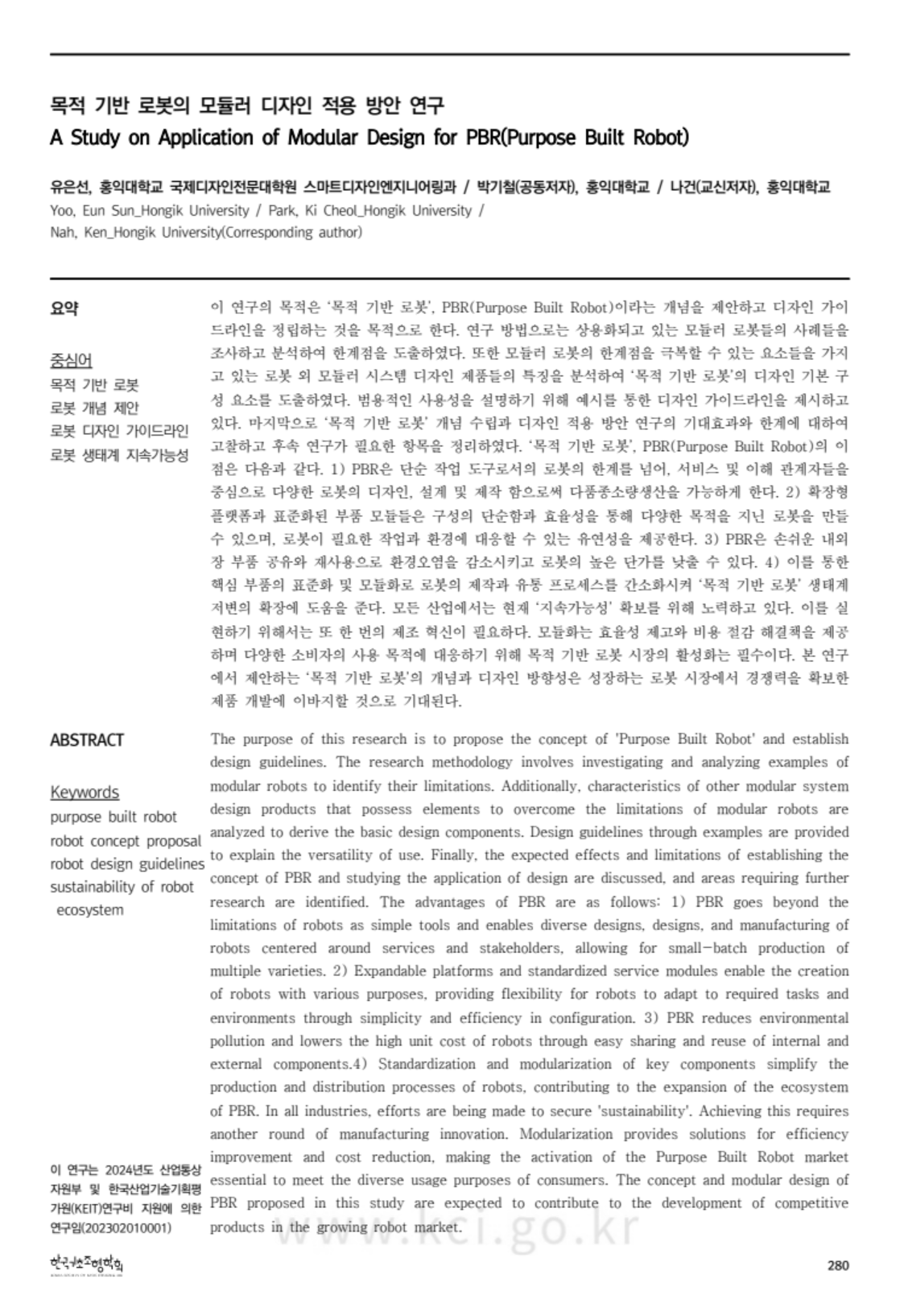
Topic: A Study on Application of Modular Design for PBR(Purpose Built Robot)
This study proposes the concept of the Purpose Built Robot (PBR) as a new manufacturing paradigm required by the future robot market and explores methods for applying modular design to realize this concept. The background of the study lies in social challenges such as low birth rates, population aging, labor shortages, and declining productivity, along with the rapidly growing demand for service robots. The existing robot market is shifting from a vertically integrated structure to a horizontally specialized one, and as the concept of Robot as a Service (RaaS) spreads, the need for small-batch, multi-variety robots capable of fulfilling diverse purposes is increasing. By analyzing existing modular robot cases and identifying their limitations, this study proposes a new robot design guideline that incorporates modular system cases from other industries in order to overcome these constraints.
The study first reviews the concept and evolution of modular design and analyzes commercialized modular robot cases such as Fetch Robotics and Korea’s Cobot. These robots can perform various purposes by separating the platform and service modules; however, it was confirmed that their usability expansion is limited due to insufficient standardization and modularization of components. To address these limitations, the study refers to modular cases in architecture, furniture, and heavy equipment. In particular, the SPMT system of Mammoet in the Netherlands and the modular furniture system of USM in Switzerland were examined to emphasize the standardization of platforms and exterior panels, as well as the possibilities of flexible combinations.
Based on this review, the study defines the core concept of PBR. Unlike integrated robots or conventional robots based on shared platforms, PBR has a structure in which platform modules and service modules are subdivided and standardized, enabling easy transformation according to purpose and application. The platform module includes the driving system and controller, while the service module consists of frame, exterior, and functional modules. The frame module forms the structural skeleton of the robot and is proposed in two types: Bar Type and Pillar Type. The exterior module is composed of flat or curved panels that shape the robot’s appearance while facilitating maintenance. The functional module allows various devices, such as displays, robot arms, and sensors, to be attached in order to perform specific purposes. All modules secure compatibility through standardized fastening structures and are designed for easy assembly and disassembly as needed.
The study proposes specific design applications of PBR by combining one, two, and four platform modules. A single-module configuration can be used for item delivery services in hospitals or libraries and supports user interaction through displays and sensors. A two-module configuration is suitable for baggage transport and storage in airports or hotels, with a Pillar Type frame and translucent exterior panels applied to enhance usability. A four-module configuration is appropriate for loading and sorting goods in logistics warehouses or smart factories, and its efficiency is improved by attaching industrial robot arms. Furthermore, when nine modules are combined, the system can function as a mobile kiosk or a small rest area, demonstrating that PBR can expand beyond a simple robot into the domain of spatial services.
The study also presents the expected effects of the PBR concept. First, by establishing a new term and concept, it can provide an academic foundation for the robot market and strengthen global communication. Second, through the standardization and modularization of components, it can improve the efficiency of manufacturing and maintenance while reducing costs. Third, small-batch, multi-variety production becomes possible, allowing flexible responses to diverse consumer demands, which contributes to sustainability. However, the study also points out limitations: the development of PBR requires time for initial system construction and standardization, and there is difficulty in simultaneously considering structure and appearance from the design stage.
In conclusion, this study newly proposes the concept of PBR and suggests practical ways of applying modular design to realize it. PBR demonstrates the potential to evolve beyond conventional robots designed for single purposes into robots capable of responding to various industrial and everyday life domains. In addition, through standardized modular design, it presents a way to simplify assembly and disassembly processes while simultaneously achieving cost reduction and sustainability. Future research should verify the practical validity of PBR through prototype development and user evaluation, and continue deeper investigations into the specifications and fastening structures of each module. The Purpose Built Robot and modular design proposed in this study are expected to contribute to innovation in the robot industry and to the establishment of a sustainable ecosystem in the future.
주제: 목적 기반 로봇의 모듈러 디자인 적용 방안 연구
본 연구는 미래 로봇 시장에서 요구되는 새로운 제조 패러다임으로서 ‘목적 기반 로봇(Purpose Built Robot, PBR)’의 개념을 제안하고, 이를 구현하기 위한 모듈러 디자인 적용 방안을 탐구한다. 연구의 배경에는 저출산과 고령화, 인력 부족, 생산성 저하라는 사회적 문제와 더불어 서비스 로봇 수요의 급증이 있다. 기존의 로봇 시장은 수직 통합형 구조에서 수평 분업형 구조로 전환되고 있으며, 서비스로서의 로봇(RaaS) 개념이 확산되면서 다양한 목적을 충족할 수 있는 다품종 소량생산형 로봇의 필요성이 커지고 있다. 본 연구는 기존 모듈러 로봇 사례를 분석하여 한계를 도출하고, 이를 극복하기 위해 다른 산업의 모듈러 시스템 사례를 접목시켜 새로운 로봇 디자인 가이드라인을 제시하였다.
연구는 먼저 모듈러 디자인의 개념과 발전 과정을 살펴보고, Fetch Robotics와 한국의 Cobot 등 상용화된 모듈러 로봇 사례를 분석하였다. 이들 로봇은 플랫폼과 서비스 모듈을 이원화하여 다양한 목적을 수행할 수 있으나, 부품의 표준화와 모듈화가 부족해 사용성 확장에 한계가 있음을 확인하였다. 이를 극복하기 위해 건축, 가구, 중장비 분야의 모듈러 사례를 참고하였으며, 특히 네덜란드 Mammoet의 SPMT, 스위스 USM의 모듈 가구 시스템을 통해 플랫폼과 외관 패널의 규격화와 조합의 가능성을 강조하였다.
이러한 고찰을 바탕으로 PBR의 핵심 개념을 정의하였다. PBR은 일체형 로봇이나 기존의 플랫폼 공유형 로봇과 달리, 플랫폼 모듈과 서비스 모듈을 세분화·표준화하여 목적과 용도에 따라 손쉽게 변형이 가능한 구조를 지닌다. 플랫폼 모듈은 구동계와 제어기를 포함하며, 서비스 모듈은 프레임, 외관, 기능 모듈로 구성된다. 프레임 모듈은 로봇의 구조적 골격을 이루며 Bar Type과 Pillar Type 두 가지 형태로 제안되었다. 외관 모듈은 평면이나 곡면 패널로 이루어져 로봇의 외형을 형성하며 유지보수가 용이하다. 기능 모듈은 디스플레이, 로봇 팔, 센서 등 다양한 장치를 장착하여 특정 목적을 수행할 수 있다. 모든 모듈은 표준화된 체결 구조를 통해 호환성을 확보하고, 필요에 따라 조립과 해체가 용이하도록 설계된다.
연구는 플랫폼 모듈 1개, 2개, 4개를 결합한 PBR의 구체적 디자인 적용 방안을 제안하였다. 1개 모듈은 병원이나 도서관에서 물품 배송 서비스용으로 활용할 수 있으며, 디스플레이와 센서를 통해 사용자와의 상호작용을 지원한다. 2개 모듈은 공항이나 호텔에서 짐 운반 및 보관용으로 적합하며, Pillar Type 프레임과 반투명 외관 패널을 적용해 사용성을 높였다. 4개 모듈은 물류창고나 스마트 팩토리에서의 물품 적재 및 분류에 적합하며, 산업용 로봇 팔을 장착해 작업 효율성을 높였다. 또한 9개 모듈을 결합하면 이동식 키오스크나 소규모 휴식 공간으로 활용이 가능해, PBR이 단순 로봇을 넘어 공간 서비스까지 확장될 수 있음을 보여주었다.
연구는 PBR 개념이 가지는 기대효과도 제시하였다. 첫째, 새로운 용어와 개념 정립을 통해 로봇 시장의 학문적 토대를 제공하고 글로벌 커뮤니케이션을 강화할 수 있다. 둘째, 부품의 표준화와 모듈화를 통해 제조와 유지보수의 효율성을 제고하고 비용을 절감할 수 있다. 셋째, 다품종 소량생산이 가능해져 소비자의 다양한 수요에 대응할 수 있으며, 이는 지속가능성을 확보하는 데 기여한다. 다만 PBR의 개발에는 초기 시스템 구축과 표준화 과정에서 시간이 필요하고, 디자인 단계부터 구조와 외관을 동시에 고려해야 하는 어려움이 따른다는 한계가 지적되었다.
결론적으로 본 연구는 PBR 개념을 새롭게 제시하고, 이를 구체적으로 실현할 수 있는 모듈러 디자인 적용 방안을 제안하였다. PBR은 단일 목적을 수행하던 기존 로봇을 넘어 다양한 산업과 생활 영역에 대응하는 로봇으로 발전할 수 있는 가능성을 보여준다. 또한 표준화된 모듈 설계를 통해 조립과 해체 과정을 단순화하고, 비용 절감과 지속가능성을 동시에 달성할 수 있는 방안을 제시하였다. 향후 연구에서는 PBR 프로토타입 제작과 사용자 평가를 통해 실질적 유효성을 검증하고, 모듈별 제원과 체결 구조에 대한 심층적 고찰을 이어갈 필요가 있다. 본 연구가 제안하는 목적 기반 로봇과 모듈러 디자인은 향후 로봇 산업의 혁신과 지속 가능한 생태계 구축에 기여할 수 있을 것으로 기대된다.
댓글 0