
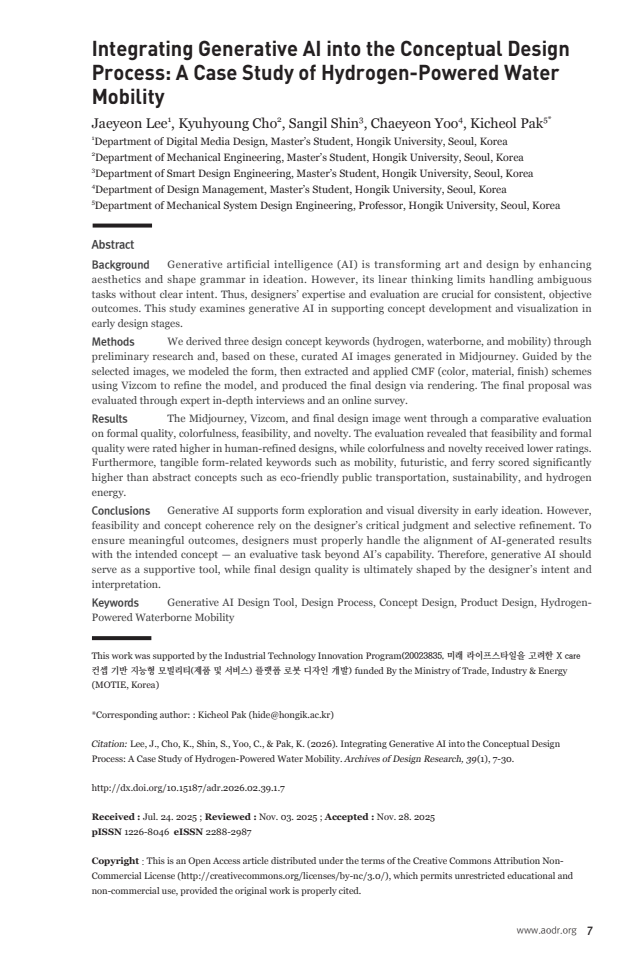
This study examines how integrating generative AI into the early stages of conceptual design changes ideation and visualization, and what is required for AI-generated outcomes to evolve into a feasible, coherent final design, using a hydrogen-powered water mobility system (Han River public water transport) as a case study. The authors first investigate the context of Han River water transit—its environment and infrastructure—along with domestic and international 사례 of water buses and ferries, and the constraints of hydrogen propulsion systems, particularly how the volume and placement of storage tanks can shape the vessel’s form. Based on this groundwork, they derive the concept keywords hydrogen–waterborne–mobility and use them as the backbone of the design direction. They then generate roughly 300 images with Midjourney while iteratively refining prompts, observing that outputs can fluctuate widely even under the same keywords and that terms such as “hydrogen” can bias results toward tank-like forms rather than coherent vessel configurations. The study documents how prompt adjustments are used to mitigate such distortions and gradually converge from speculative imagery toward realistic scale, structural logic, and an industrial form language.
For form development, the team selects key form elements from the generated images and builds a 3D model in Rhino 8, setting target specifications at 100 passengers, 27 knots, and 22 m × 9 m × 4 m. They estimate the hydrogen storage requirement at approximately 15.78 m³ and compare layout scenarios through a low-fidelity 1/20 prototype, concluding that a two-tank arrangement at the front (each 1.6 m × 4 m) is appropriate. Major powertrain components such as the fuel cell, battery, and converter are arranged in the lower hull for stability. Through this process, the study illustrates that “form inspiration” obtained from AI imagery must be reconciled with system configuration and spatial planning through engineering validation before it can function as a credible design proposal.
In the CMF phase, the authors use Vizcom to generate and compare about 200 variations of color, material, and finish while preserving the 3D form. They suggest a practical division of labor in which Midjourney excels at broad form exploration, whereas Vizcom is effective for CMF variation with the form held constant. At the same time, they emphasize that abstract keywords such as eco-friendly and sustainability can lead to unintended outcomes—such as wooden hulls or rooftop solar panels—making it necessary for designers to reframe meanings and stabilize the intended visual language through deliberate interpretation and material choices (e.g., brushed metal and chrome accents). The final design is completed through rendering, and the paper explicitly argues that conceptual consistency and quality depend less on directly adopting AI outputs and more on designers’ selection, correction, and interpretation.
Evaluation is conducted through in-depth interviews with five designers and three hydrogen-system engineers, along with an online survey. Interviews confirm that generative AI increases the speed and diversity of ideation, but they also highlight major limitations for industrial practice, including security concerns and difficulties with precise dimensions, tolerances, and manufacturability. In particular, the hydrogen system requires rigorous engineering validation around weight distribution, maintenance accessibility, ventilation, and safety. The survey compares Midjourney outputs, Vizcom results, and the final designer-refined proposal across formal quality, colorfulness, feasibility, and novelty. The final proposal scores relatively higher on feasibility and formal quality, while scoring lower on colorfulness and novelty. In addition, keyword consistency is rated high for terms that translate directly into visible form, such as ferry and mobility, but low for more abstract, system-level notions such as eco-friendly and sustainability, suggesting that translating abstraction into stable visual language remains challenging. Overall, the study concludes that while generative AI is a powerful tool for expanding form exploration and visual diversity in early design, feasibility and conceptual coherence are difficult to secure without designers’ critical judgment, engineering verification, and an iterative refinement loop. It therefore positions generative AI not as a replacement for designers, but as a supportive tool that amplifies designers’ intent and interpretation.
댓글 0