
통합 검색
통합 검색
- 작성자 HIDE
- 조회수 21
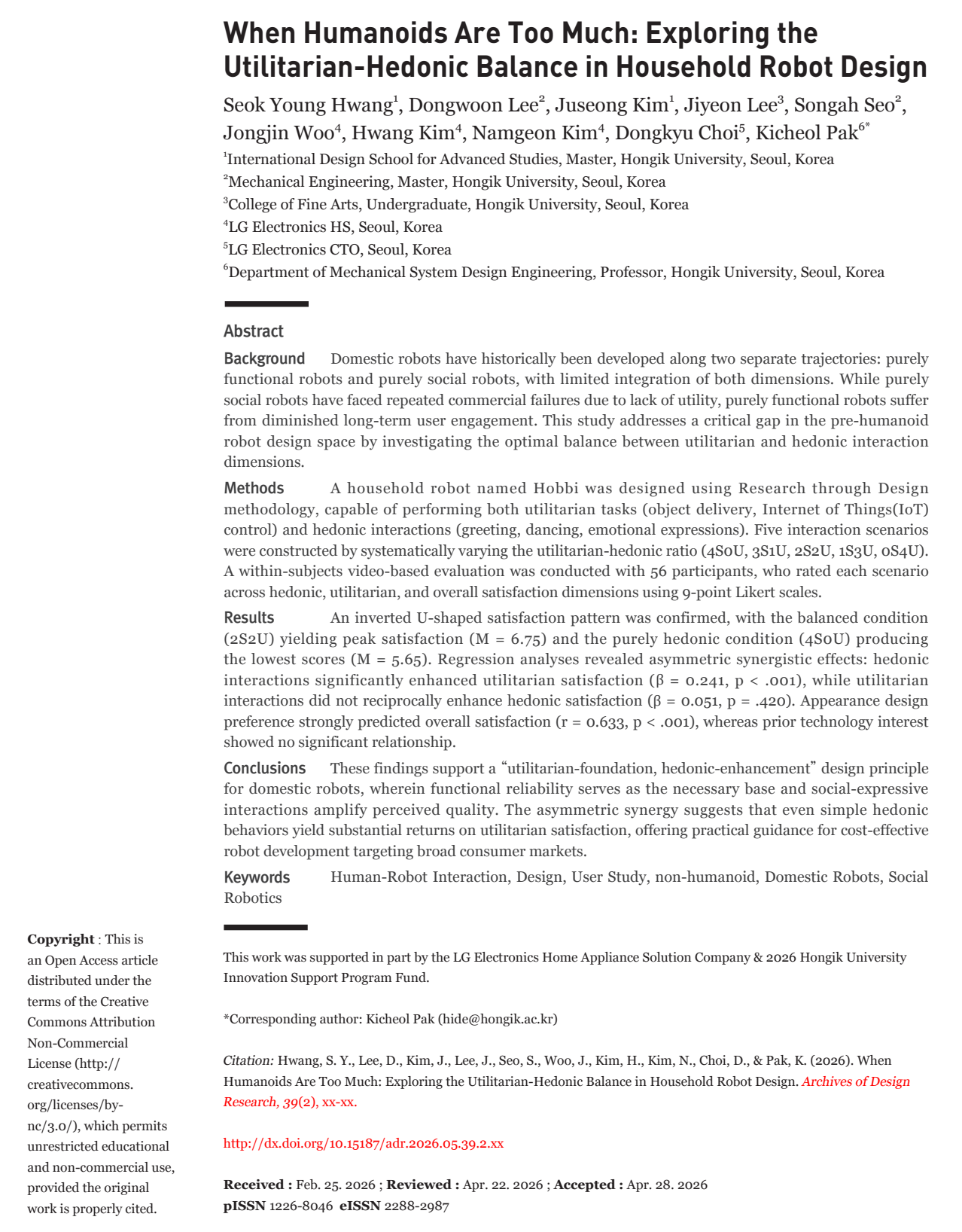
Topic: When Humanoids Are Too Much Exploring the Utilitarian-Hedonic Balance in Household Robot Design
This paper, “When Humanoids Are Too Much: Exploring the Utilitarian-Hedonic Balance in Household Robot Design,” investigates how household robots should balance practical functions and social-emotional interactions. The study begins from the observation that fully capable humanoid robots remain difficult to commercialize for ordinary homes because of high cost, technical complexity, safety concerns, and reliability issues. Instead of assuming that humanoid robots are the inevitable future of domestic robotics, the authors focus on a more realistic “pre-humanoid” design space: non-humanoid or semi-social household robots that can provide useful assistance while also creating emotional engagement.
The paper argues that domestic robots have historically followed two separate paths. One path is purely functional robots, such as cleaning robots, which perform useful tasks but may gradually be perceived as simple appliances. The other path is purely social robots, which offer emotional interaction but often fail commercially because they lack sufficient practical value. Examples such as Jibo, Kuri, and Cozmo suggest that social charm alone is not enough to justify a robot’s presence in the home. Therefore, the central research problem is not whether robots should be functional or social, but what ratio of utilitarian and hedonic interaction creates the highest level of user satisfaction.
To explore this question, the authors designed a household robot called Hobbi using a Research through Design approach. Hobbi was developed as a non-humanoid domestic robot capable of both utilitarian and hedonic interactions. Its utilitarian functions include object delivery, beverage delivery, furniture relocation, and IoT appliance control. Its hedonic or social-expressive interactions include greeting the user, responding positively, expressing joy, and dancing or enjoying time together. The robot’s form was designed to avoid excessive anthropomorphism while still conveying a friendly domestic character. It adopted a soft, rounded, and familiar appearance, using textile-like qualities and an abstract form to reduce psychological distance and fit naturally into the home environment.
The robot’s physical design was also carefully considered. Based on household furniture dimensions and low-fidelity mock-up tests, the final height was set at 600 mm and the diameter at 320 mm, similar to a robot vacuum cleaner. The researchers examined how users might physically interact with the robot in different postures, such as sitting, standing, or lying down, and identified key interaction zones around the head and body. Hobbi’s hardware included a 6-DoF structure with a moving head, tilting body, opening side plates, and a mobile platform. These mechanisms enabled both functional behaviors, such as carrying objects, and expressive behaviors, such as nodding, tilting, rotating, and displaying emotional eye expressions.
The user study was designed to test three research questions. First, the authors asked which utilitarian-hedonic ratio would maximize user satisfaction. Second, they examined whether the two dimensions would interact synergistically: whether hedonic interactions enhance perceived utilitarian value, or whether utilitarian interactions enhance perceived hedonic value. Third, they investigated whether individual factors such as appearance preference and prior interest in robots or technology influence satisfaction. Five video-based scenarios were created by systematically varying the ratio of social and utilitarian interactions: 4S0U, 3S1U, 2S2U, 1S3U, and 0S4U. Each participant watched all five scenarios and evaluated them using 9-point Likert scales across hedonic, utilitarian, and overall satisfaction dimensions.
The study involved 56 participants, including design majors, engineering majors, and participants from other fields. The results showed a clear inverted U-shaped satisfaction pattern. The balanced condition, 2S2U, produced the highest overall satisfaction score, while the purely hedonic condition, 4S0U, produced the lowest score. This suggests that users do not prefer a household robot that only performs cute or social behaviors without meaningful utility. However, once practical functions are present, adding social-expressive behaviors can improve the overall experience. In other words, domestic robots should not be designed as either tools or companions alone; they should integrate both roles, with practical utility serving as the foundation.
A key contribution of the paper is the finding of asymmetric synergy. Hedonic interactions significantly enhanced utilitarian satisfaction, meaning that users perceived the robot’s functional performance more positively when social-expressive behaviors were included. However, the reverse effect was not significant: utilitarian functions did not meaningfully enhance hedonic satisfaction. This finding supports the design principle of “utilitarian foundation, hedonic enhancement.” Functional reliability must come first, but even relatively simple expressive behaviors can amplify perceived usefulness and make the robot feel more acceptable, pleasant, and competent.
The study also found that appearance design preference strongly predicted overall satisfaction. Participants who liked Hobbi’s appearance tended to evaluate the robot more positively overall. By contrast, prior interest in robots or technology did not significantly affect satisfaction. This suggests that well-designed domestic robots may appeal not only to technology enthusiasts but also to general consumers. The study also observed a small gender effect, with female participants reporting somewhat higher satisfaction, but the effect size was modest compared with the influence of the utilitarian-hedonic ratio.
The authors conclude that future household robots should be developed through an integrated design strategy. Designers should first secure reliable utilitarian functions, then embed hedonic behaviors into functional contexts rather than adding them superficially afterward. Appearance should also be treated as a strategic factor, not merely an aesthetic detail. The paper’s practical recommendation is that cost-effective domestic robots do not need to become full humanoids; instead, they can achieve user acceptance by combining useful domestic assistance with carefully calibrated social-expressive interaction.
The paper acknowledges several limitations. The evaluation was video-based rather than conducted through live physical interaction, so it could not fully capture tactile, spatial, or long-term co-presence effects. The sample was also limited to young adult participants, which may not represent key domestic robot users such as older adults, single-person households, or families with children. Future studies should therefore test similar utilitarian-hedonic ratios through long-term, in-home interaction studies with more diverse user groups and different robot morphologies. Despite these limitations, the study provides useful empirical evidence for designing domestic robots that are neither overly humanoid nor merely appliance-like, but balanced, approachable, and functionally meaningful.
댓글 0