
통합 검색
통합 검색
- 작성자 hide
- 조회수 182
Topic: User-centered Advanced Air Mobility(AAM) Cabin Spatial Design
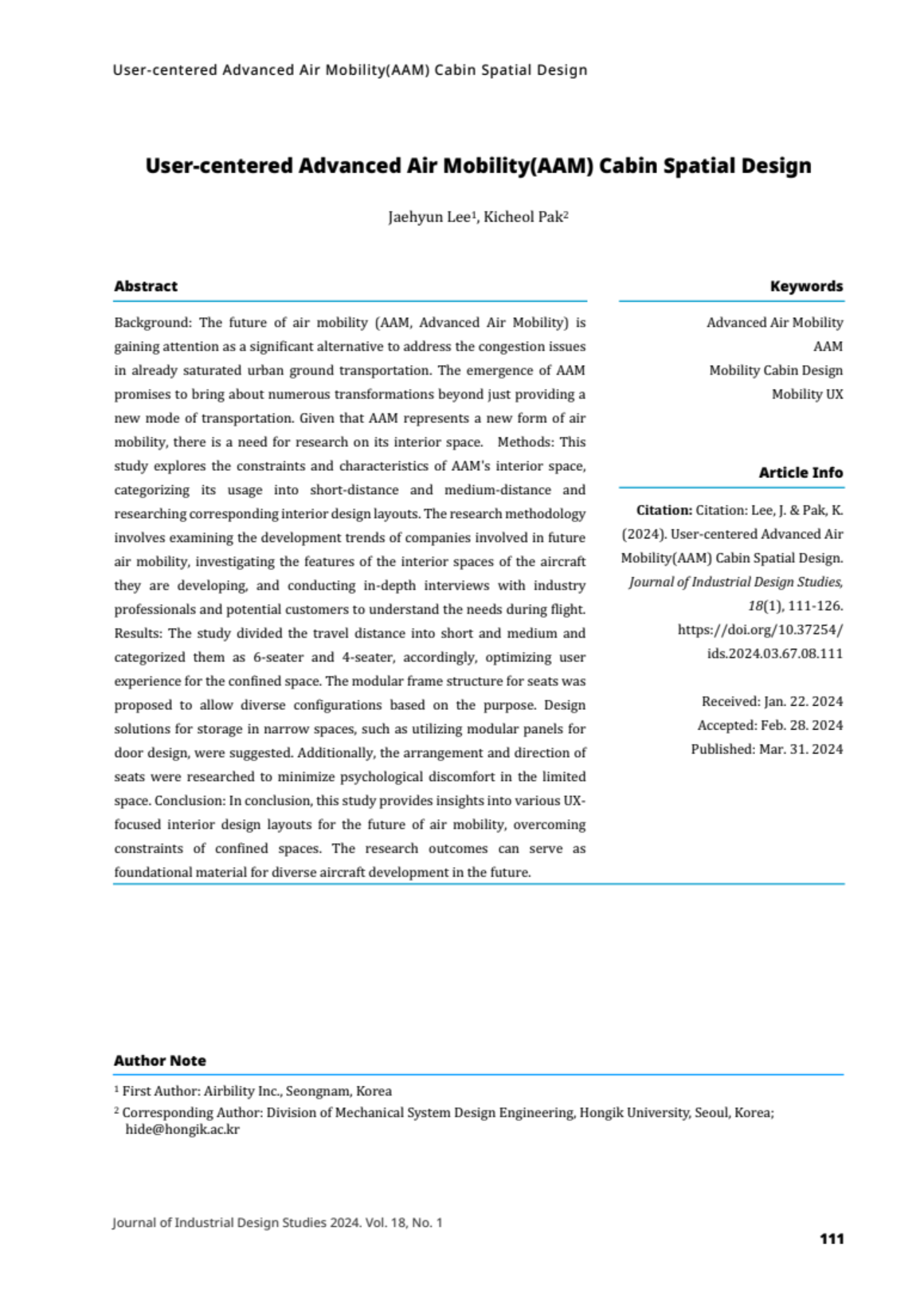
This study aims to explore the cabin space design of Advanced Air Mobility (AAM), which has been gaining attention as a promising alternative for alleviating urban traffic congestion, from a user-centered perspective. AAM has the potential not only to provide a new mode of transportation but also to trigger transformative changes across various domains, including both intra-city mobility and inter-city connectivity. In particular, as the development of electric Vertical Take-Off and Landing (eVTOL) aircraft accelerates, the need for design research that optimizes user experience within confined cabin environments has become increasingly important. Through a review of prior literature, an investigation of industry trends, and in-depth interviews with aviation professionals and potential users, this study identifies the constraints and possibilities of AAM cabin spaces and proposes design layouts that reflect user experience.
The study first clarifies the concept of AAM and its application domains, which are categorized into Urban Air Mobility (UAM) and Regional Air Mobility (RAM). It also presents market forecasts predicting that the sector will grow to approximately USD 255 billion by 2035. In addition, the study compares and analyzes the aircraft and cabin designs of major eVTOL companies, including Lilium, Vertical, Archer, and Wisk, confirming differences in seating configurations, cockpit structures, and levels of autonomous flight. Subsequently, interviews were conducted with six aviation industry professionals and potential users to examine preferences regarding seating arrangements, the utilization of in-cabin amenities, and activity patterns during short- and medium-range flights. The results showed that most respondents preferred forward-facing seating arrangements when sharing the cabin with strangers, and the same tendency was observed even when traveling with family members or acquaintances. The use of storage space and in-cabin amenities was found to be relatively high, whereas the demand for partitions was comparatively low. During short-range flights, active behaviors such as conversation and enjoying the scenery were preferred, while during medium-range flights, personal activities such as resting and sleeping were more favored.
Based on these findings, the study proposes design directions to overcome the constraints of cabin space. First, a lightweight frame structure and modular seating system were applied to enable various configurations tailored to the characteristics of UAM and RAM. For cabins accommodating three to six passengers, comfort was ensured through the design of headrests and cushion structures, and an optional modular design was proposed. Second, in terms of storage space and door design, the study introduced a method of efficiently utilizing limited space through modular panels. This approach goes beyond simple baggage storage, demonstrating the possibility of expansion into modular storage systems capable of accommodating clothing and personal items. Third, regarding seating arrangements, the study proposed a basic forward-facing layout for six-seat UAM cabins, while for RAM it additionally suggested a four-seat zigzag arrangement and an outward-facing layout to enhance space efficiency and passenger independence. In particular, for RAM, a seat-to-seat distance of at least 540 mm was secured in order to guarantee personal storage space and privacy, thereby providing a level of comfort suitable for longer-distance travel.
The study also examined seat rotation angles of 5, 10, 15, and 20 degrees as a means of reducing psychological discomfort between passengers while creating a greater sense of visual openness. In terms of color application, the study suggested using bright and lively colors in UAM cabins to create a light and energetic atmosphere, whereas in RAM cabins, neutral tones were proposed to provide a sense of stability and reduce fatigue during longer journeys.
In conclusion, this study emphasizes that a user-centered approach is essential in the design of AAM cabin spaces. In order to simultaneously satisfy users’ psychological comfort and convenience within a constrained cabin environment, a range of design strategies is required, including seating arrangements, frame structures, amenity spaces, and modular storage systems. In particular, because UAM and RAM differ in travel duration and purpose, differentiated design strategies are necessary: UAM should prioritize efficiency and a sense of intimacy for short-distance travel, whereas RAM should focus on independence and comfort for medium-distance travel. By presenting specific user-centered design elements and layout proposals, this study is expected to serve as a foundational reference for future AAM aircraft development and empirical research.
주제: 사용자 중심의 미래 항공 모빌리티(AAM) 캐빈 공간 디자인 연구
이 연구는 도심 교통 혼잡을 해결할 대안으로 주목받고 있는 미래 항공 모빌리티(AAM, Advanced Air Mobility)의 캐빈 공간 디자인을 사용자 중심 관점에서 탐구하는 것을 목적으로 한다. AAM은 단순히 새로운 교통수단을 제공하는 것을 넘어, 도시 내 이동과 도시 간 연결을 포함한 다양한 영역에서 혁신적 변화를 촉발할 잠재력을 지니고 있다. 특히 eVTOL(electric Vertical Take-Off and Landing) 기반 기체의 개발이 가속화되면서 좁은 기내 공간에서 사용자 경험을 최적화하는 디자인 연구의 필요성이 대두되고 있다. 본 연구는 선행 문헌 검토, 기업 동향 조사, 실제 항공 산업 종사자 및 잠재 사용자와의 심층 인터뷰를 통해 AAM 캐빈 공간의 제약과 가능성을 규명하고, 사용자 경험을 반영한 디자인 레이아웃을 제안한다.
연구는 먼저 AAM의 개념과 UAM(Urban Air Mobility), RAM(Regional Air Mobility)으로 구분되는 적용 범위를 정리하고, 시장 전망을 통해 2035년까지 약 2550억 달러 규모로 성장할 것이라는 예측을 소개하였다. 또한 주요 eVTOL 기업인 Lilium, Vertical, Archer, Wisk의 기체와 캐빈 디자인을 비교 분석하여 좌석 배열, 조종석 구조, 자율 비행 여부 등에서 차이를 확인하였다. 이후 여섯 명의 항공업 종사자 및 잠재 이용자를 대상으로 인터뷰를 실시하여 좌석 배치 선호, 기내 편의 요소 활용도, 단거리 및 중거리 비행 시 활동 패턴을 조사하였다. 결과적으로 대부분의 응답자는 낯선 사람과 동승할 경우 앞보기 배열을 선호하고, 가족·지인과 함께할 경우에도 동일한 경향을 보였다. 또한 수납공간과 기내 비품에 대한 활용도가 높았으며, 칸막이에 대한 수요는 상대적으로 낮았다. 단거리 비행에서는 대화, 풍경 감상 등 활동적 요소가, 중거리 비행에서는 휴식과 수면 등 개인적 활동이 선호되는 것으로 나타났다.
이를 토대로 연구는 캐빈 공간의 제약을 극복할 수 있는 디자인 방향성을 제시하였다. 첫째, 경량화된 프레임 구조와 모듈화된 좌석을 적용하여 UAM과 RAM 각각의 특성에 맞는 다양한 구성을 가능하게 하였다. 3~6인승 규모의 캐빈에서 헤드레스트와 쿠션 구조를 통해 편안성을 보장하고, 선택적으로 적용할 수 있는 모듈형 설계를 제안하였다. 둘째, 수납공간과 도어 디자인에서는 모듈 패널을 활용하여 한정된 공간을 효율적으로 사용할 수 있는 방식을 도입하였다. 이는 단순히 짐을 보관하는 기능을 넘어, 의류나 잡화를 수납할 수 있는 모듈형 수납장치로 확장 가능성을 보여준다. 셋째, 좌석 배열은 UAM에서는 6인승 기준 기본 앞보기 배열을 중심으로, RAM에서는 4인승 지그재그 배열과 외부보기 배열을 추가하여 공간 활용성과 독립성을 강화하였다. 특히 RAM의 경우 좌석 간 거리를 540mm 이상 확보하여 개인 수납공간과 프라이버시를 보장하고, 장거리 이동에 적합한 쾌적성을 제공하도록 하였다.
연구는 또한 좌석 회전 각도를 5도, 10도, 15도, 20도로 조정하여 탑승자 간 심리적 불편을 줄이고 시각적 개방감을 제공할 수 있는 방안을 검토하였다. UAM에서는 밝고 경쾌한 색채를 통해 가벼운 분위기를 조성하는 반면, RAM에서는 안정감을 주는 무채색 계열을 적용하여 긴 이동에 따른 피로를 완화하는 방식을 제안하였다.
결론적으로 본 연구는 AAM 캐빈 공간 디자인에서 사용자 중심 접근이 필수적임을 강조한다. 제한된 기내 환경에서 사용자의 심리적 안정과 편의성을 동시에 충족시키기 위해 좌석 배열, 프레임 구조, 편의 공간, 모듈화된 수납 시스템 등 다양한 디자인 전략이 요구된다. 특히 UAM과 RAM은 이동 시간과 목적이 상이하므로, UAM은 단거리 중심의 효율성과 친밀감을, RAM은 중거리 중심의 독립성과 쾌적성을 지향하는 차별적 전략이 필요하다. 본 연구는 이러한 사용자 중심의 디자인 요소와 레이아웃을 구체적으로 제시함으로써 향후 AAM 기체 개발과 실증 연구의 기초 자료로 활용될 수 있을 것으로 기대된다.
댓글 0