
통합 검색
통합 검색
- 작성자 hide
- 조회수 236
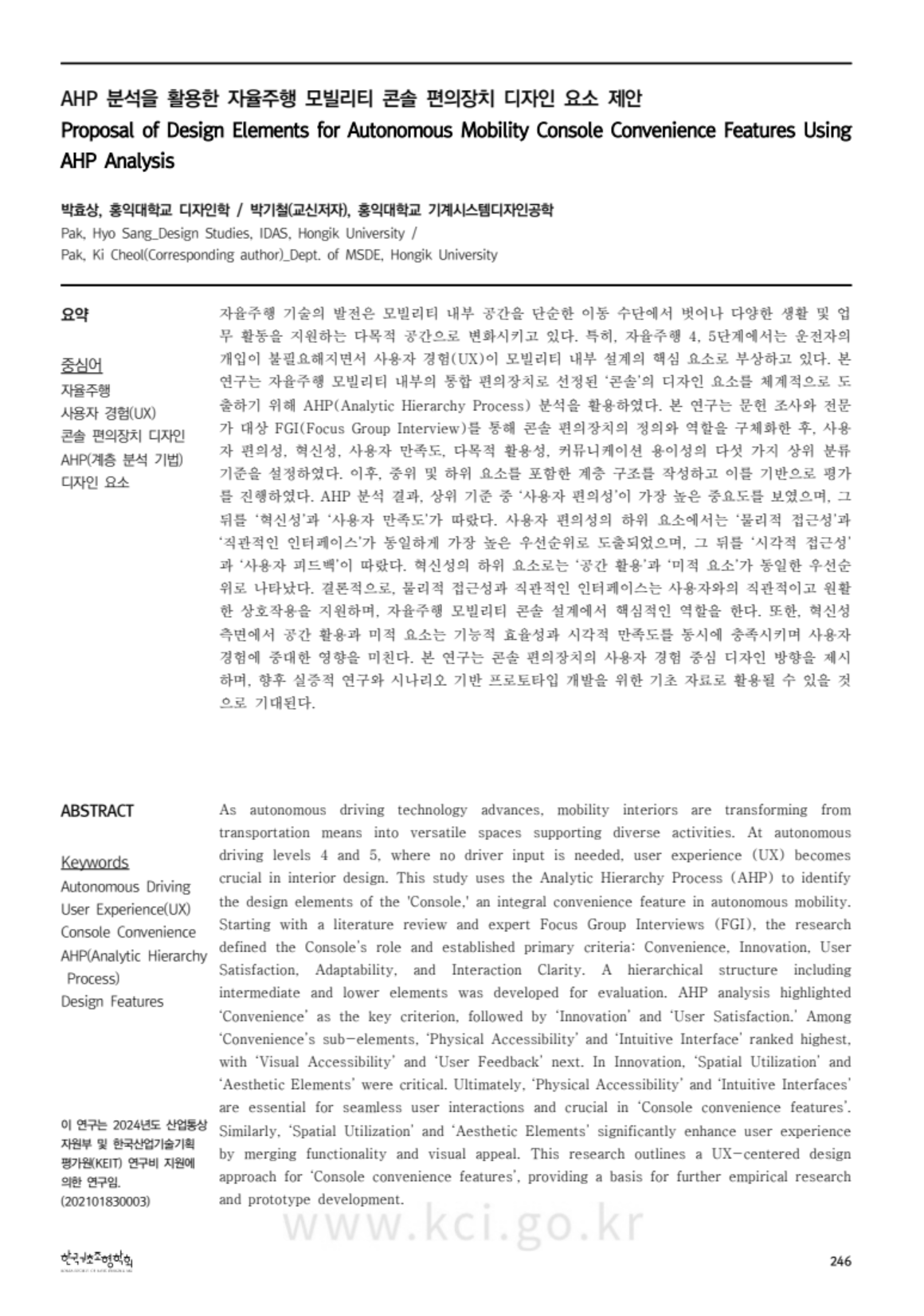
This study begins with the premise that advancements in autonomous driving technology are transforming the interior of mobility systems from simple means of transportation into multifunctional spaces that support a wide range of daily and professional activities. In particular, at Levels 4 and 5 of autonomous driving—where driver intervention is no longer required—the user experience (UX) emerges as the central focus of mobility interior design. Accordingly, this research concentrates on the console, which serves as an integrated convenience device and a key interface that connects multiple subsystems within the vehicle. Beyond merely providing information or control functions, the console is conceptualized as a core medium for intuitive and seamless user interaction. The objective of this study is to systematically identify and categorize the design elements of console-based convenience devices to provide design guidelines for future autonomous mobility interiors.
The research employed literature review and focus group interviews (FGI) with domain experts to refine the definition and role of console convenience systems. Based on this groundwork, five upper-level evaluation criteria were established: user convenience, innovativeness, user satisfaction, multi-purpose usability, and communication ease. Each criterion was then decomposed into middle- and lower-level elements, forming a hierarchical structure. To quantitatively assess the relative importance of these criteria, the Analytic Hierarchy Process (AHP) method was applied. The survey targeted 30 university students aged 20–29, who watched a recorded video of the interior of the Zoox autonomous ride-sharing taxi and responded based on their indirect experience, allowing for experiential evaluation without physical interaction.
The AHP results indicated that user convenience ranked as the most important upper-level criterion, followed by innovativeness and user satisfaction. The criteria of multi-purpose usability and communication ease were excluded due to low response reliability. Among the lower-level elements, physical accessibility and intuitive interface design shared the highest priority, followed by visual accessibility and user feedback. These findings suggest that physical and visual affordances, along with immediate system feedback, are essential for enabling intuitive interaction in console design. In terms of innovativeness, spatial utilization and aesthetic quality were rated equally high, highlighting the necessity of balancing functional efficiency and aesthetic satisfaction. Conversely, within the user satisfaction category, sub-elements such as seat comfort and temperature control were given relatively lower importance, implying that users prioritize interface usability over environmental comfort in autonomous contexts.
Based on these findings, the study concludes that accessibility, interface intuitiveness, and the integration of functionality and aesthetics are critical factors in designing console systems for autonomous mobility interiors. The research underscores a shift from mere technological innovation to human-centered experiential design, providing a conceptual foundation for empirical studies and prototype development in future mobility environments.
However, several limitations are acknowledged. First, the use of video-based indirect evaluation limited the realism of participants’ experiences, which may have affected response reliability in some categories. Second, the participant group consisted solely of university students in their twenties, restricting the generalizability of results across different age groups, occupations, and vehicle ownership backgrounds. Third, the identical weighting of certain sub-elements indicates a need for further refinement and detailed categorization in future studies. Fourth, the study did not include a technical feasibility assessment of the proposed design features; thus, the stability and commercial viability of large-scale displays and complex interactive technologies in actual autonomous driving conditions remain open questions.
Future research should include immersive evaluations using virtual reality (VR), empirical testing in real autonomous vehicles, and diverse participant groups to enhance representativeness. Furthermore, expanding the classification of detailed design elements and assessing technical implementability will contribute to improving both the validity and practical applicability of console design guidelines. Through these advancements, the study aims to strengthen the theoretical and empirical foundation for human-centered console design in next-generation autonomous mobility systems.
주제: AHP 분석을 활용한 자율주행 모빌리티 콘솔 편의장치 디자인 요소 제안
본 연구는 자율주행 기술의 발전에 따라 모빌리티 내부 공간이 단순한 이동 수단을 넘어 다양한 생활 및 업무 활동을 지원하는 다목적 공간으로 변화하고 있음을 전제로 한다. 특히 자율주행 4단계와 5단계에 이르면 운전자의 개입이 불필요해지면서, 사용자 경험(UX)이 모빌리티 내부 설계의 핵심으로 부상한다. 이에 연구는 모빌리티 내부에서 통합적 편의 장치로서 중요한 역할을 하는 콘솔에 주목하였다. 콘솔은 단순히 정보 제공이나 제어 기능을 넘어, 다양한 장치와 연계되어 사용자에게 직관적이고 편리한 상호작용을 제공하는 핵심 인터페이스로 정의된다. 연구의 목적은 콘솔 편의장치의 디자인 요소를 체계적으로 도출하여 향후 자율주행 모빌리티 설계 가이드로 활용하는 데 있다.
연구 방법은 문헌 조사와 전문가 대상 포커스 그룹 인터뷰(FGI)를 통해 콘솔 편의장치의 정의와 역할을 구체화하고, 이를 기반으로 사용자 편의성, 혁신성, 사용자 만족도, 다목적 활용성, 커뮤니케이션 용이성의 다섯 가지 상위 기준을 도출하였다. 이후 각 상위 기준을 중위와 하위 요소로 세분화하여 계층 구조를 설정하고, AHP(Analytic Hierarchy Process) 기법을 통해 중요도를 정량적으로 평가하였다. 연구 설문은 20~29세 대학생 30명을 대상으로 진행되었으며, Zoox 공유형 자율주행 택시 내부를 촬영한 동영상을 시청한 후 응답하도록 설계하여 간접 경험 기반 평가를 가능하게 하였다.
AHP 분석 결과, 상위 기준 중 사용자 편의성이 가장 높은 중요도를 차지했으며, 그 뒤를 혁신성과 사용자 만족도가 이었다. 다목적 활용성과 커뮤니케이션 용이성은 응답의 신뢰도가 낮아 분석에서 제외되었다. 하위 요소에서는 물리적 접근성과 직관적인 인터페이스가 동일하게 가장 높은 순위를 기록하였고, 시각적 접근성과 사용자 피드백이 뒤를 이었다. 이는 콘솔 설계에서 사용자가 직관적으로 기능을 인식하고 조작할 수 있는 물리적·시각적 장치와 즉각적 피드백이 핵심적임을 시사한다. 혁신성 측면에서는 공간 활용과 미적 요소가 동일하게 높은 순위를 보여, 기능적 효율성과 심미적 만족을 동시에 고려한 설계가 필요함을 강조한다. 반면, 사용자 만족도의 세부 항목 중 좌석의 편안함, 실내 온도 조절 등은 상대적으로 낮은 우선순위를 보였다.
연구는 이를 통해 자율주행 모빌리티 내부 콘솔 설계에서 직관적 상호작용을 지원하는 접근성과 인터페이스, 그리고 기능성과 미학을 동시에 충족하는 공간 활용과 심미적 디자인이 핵심 요소임을 밝혀냈다. 이는 단순한 기술적 혁신이 아니라 사용자 중심적 경험 설계를 강조하는 관점으로, 향후 실증적 연구와 프로토타입 개발을 위한 기초 자료가 될 수 있음을 제안한다.
그러나 본 연구는 몇 가지 한계를 가진다. 첫째, 동영상 기반 간접 경험을 통한 평가가 실제 주행 환경에서의 경험을 충분히 반영하지 못했다는 점이다. 일부 항목에서 응답 신뢰도가 낮았던 것은 이러한 한계를 보여준다. 둘째, 피험자 집단이 20대 대학생으로 한정되어 있어 다양한 연령과 직업군, 차량 소유 여부를 충분히 반영하지 못했다. 셋째, 일부 하위 요소의 동일 가중치는 더 세분화된 기준이 필요함을 시사한다. 넷째, 제안된 기능의 실제 기술적 구현 가능성에 대한 검토가 부족하였다. 특히 대형 디스플레이나 복합 기술이 자율주행 환경에서 안정적으로 상용화될 수 있을지 여부는 추가 연구가 필요하다.
향후 연구에서는 가상현실(VR)을 활용한 몰입형 경험 제공, 실제 자율주행 차량에서의 사용자 데이터 수집 등 실증적 검증이 필요하다. 또한 다양한 사용자 집단을 대상으로 한 확장 연구와 세부 요소의 추가 분류, 기술적 구현 가능성 검토가 이루어져야 한다. 이를 통해 자율주행 모빌리티 콘솔 편의장치 디자인 요소의 타당성과 실효성을 높일 수 있을 것이다.
댓글 0