
통합 검색
통합 검색
- 작성자 hide
- 조회수 119
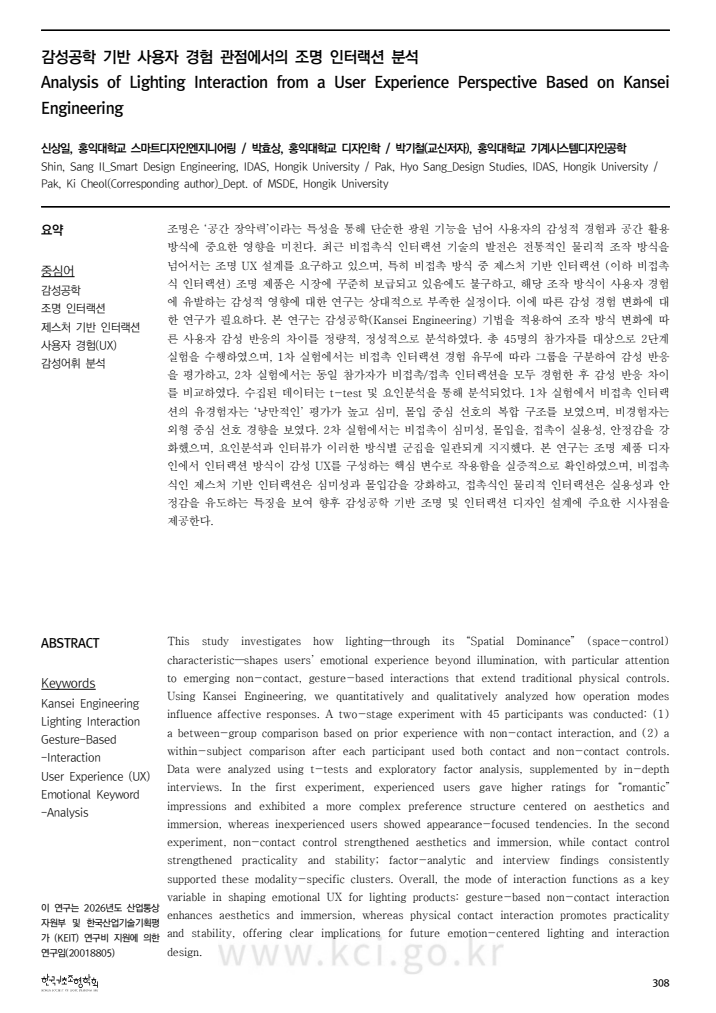
Topic: Analysis of Lighting Interaction from a User Experience Perspective Based on Kansei Engineering
This study empirically examines how different lighting interaction modes influence user experience and emotional impressions from the perspective of Kansei Engineering. The research begins from the understanding that lighting is not merely a functional light source for illumination, but also a key medium that shapes spatial atmosphere and users’ emotional experiences. In particular, with the recent spread of smart lighting technologies, non-contact interaction methods using hand gestures have emerged and begun to provide user experiences distinct from conventional contact-based interfaces such as buttons, dials, and touch controls. Despite this shift, there has been insufficient research on how these differences in control modality produce differences in emotional responses. Accordingly, this study aims to systematically identify how changes in lighting control methods affect emotional UX dimensions such as aesthetics, immersion, practicality, and stability.
The study is structured around three hypotheses. First, users with prior non-contact interaction experience and those without such experience would differ in their emotional evaluations of lighting. Second, when the same users experience both contact-based and non-contact-based interaction, the interaction mode itself would lead to significant differences in their affective evaluations. Third, depending on interaction experience and mode, the structural organization of emotional vocabularies perceived by users—that is, the factor structure of emotional cognition—would differ. These hypotheses go beyond comparing mean scores and instead examine whether interaction mode acts as a core design variable that changes the organizing principles of emotional evaluation in lighting UX.
To test these hypotheses, the researchers recruited a total of 45 participants in their 20s and 30s, balancing design majors and engineering majors. The experiment was conducted in two stages. In the first stage, participants with prior non-contact interaction experience (Group A) and those without such experience (Group B) were compared in terms of their emotional responses to the same non-contact lighting prototype. In the second stage, the same participants experienced both contact-based (Group C) and non-contact-based (Group D) interaction modes and then evaluated each mode using emotional descriptors. A total of 25 emotional keywords were selected through big-data analysis using Sometrend and subsequent content validity review, and each was measured using a five-point Likert scale. The experimental lighting prototype itself was developed by first generating design concepts through generative AI, selecting a final design based on aesthetics and functionality, and then fabricating a working mock-up capable of non-contact interaction. Quantitative data were analyzed using t-tests and factor analysis, while in-depth interviews were conducted to triangulate the findings with qualitative insights.
The results of the first experiment showed that the group with prior non-contact interaction experience rated the lighting significantly higher on the emotional keyword “romantic” than the inexperienced group. Factor analysis further revealed that the experienced group formed a more complex emotional structure involving luxury, practicality, modernity, pleasantness, and harmony, whereas the inexperienced group displayed a more visually oriented and appearance-based structure centered on sophistication, desirability, attractiveness, and tradition. In the in-depth interviews, experienced users described the gesture-based interaction as “novel,” “intuitive,” “like interacting with the lamp,” and even “like performing magic,” indicating that actual interaction experience contributed to emotional immersion and a sense of agency. By contrast, the inexperienced group focused more on design appearance, spatial suitability, and expectations or frustrations regarding operability, suggesting that without direct use experience, the lighting was perceived more as a visual object than as an emotionally interactive medium.
In the second experiment, where the same users experienced both contact and non-contact interaction modes, significant differences were found in the emotional descriptors “want,” “want to own,” and “practical.” The paper interprets these findings as showing that non-contact interaction strengthens an emotional axis of aesthetics and immersion, whereas contact interaction reinforces practicality and stability. Factor analysis supported this interpretation: the contact mode clustered around emotional stability, efficiency, warmth, and traditionality, while the non-contact mode clustered around flamboyance, prettiness, modernity, comfort, and coziness, reflecting an aesthetic-immersion orientation. The in-depth interviews also supported these patterns. Participants experiencing the contact mode emphasized control, clear feedback, and functional expansion, whereas those experiencing the non-contact mode highlighted novelty, interest, a sense of communication, hygiene, and immersion. In particular, non-contact users described the experience as “feeling like a magician,” “making me want to keep interacting,” and “a harmonious combination of design and movement,” indicating that the act of interaction itself became an important part of the emotional experience.
Overall, this study demonstrates that interaction mode in lighting UX is not merely a means of functional control, but a key variable that determines the direction and structure of emotional perception. Non-contact interaction is particularly effective in enhancing aesthetic impressions and immersion, making it well suited for exhibition, experience-centered, and emotionally expressive spatial contexts. In contrast, contact interaction reinforces control, practicality, and stability, making it more appropriate for contexts where task performance, reliability, and safety are important. The study also shows that accumulated interaction experience transforms users’ emotional structure from a simple appearance-based evaluation into a richer and more immersive interpretation. Based on these findings, the authors argue that future lighting UX design should strategically select interaction modes according to target emotions and user experience stages. For users who are unfamiliar with non-contact interaction, simple onboarding procedures and immediate feedback should be provided so that their evaluations can shift from surface-level appearance judgments to interpretations grounded in actual interaction experience. At the same time, the study acknowledges its limitations, including a limited sample size, a single lighting form, and a restricted range of interaction types. It therefore suggests that future research should expand to more diverse user groups, real spatial contexts, multimodal interaction methods such as voice, and individual user characteristics.
주제: 감성공학 기반 사용자 경험 관점에서의 조명 인터랙션 분석
본 연구는 감성공학(Kansei Engineering) 관점에서 조명의 인터랙션 방식이 사용자 경험과 감성적 인상 형성에 어떠한 차이를 유발하는지를 실증적으로 분석한 논문이다. 연구의 출발점은 조명이 단순히 공간을 밝히는 기능적 광원을 넘어, 공간 분위기와 사용자의 정서적 경험을 형성하는 중요한 매개체라는 인식에 있다. 특히 최근 스마트 조명 기술의 확산과 함께 손 제스처를 활용한 비접촉식 조작 방식이 등장하면서, 기존의 버튼·다이얼·터치 기반 접촉식 인터랙션과는 다른 사용자 경험을 제공하고 있음에도, 이러한 조작 방식의 차이가 실제로 어떤 감성적 반응의 차이를 만들어내는지에 대한 연구는 충분하지 않았다. 이에 본 연구는 조명 조작 방식의 변화가 심미성, 몰입감, 실용성, 안정감과 같은 감성 UX 요소에 어떤 영향을 주는지를 체계적으로 규명하고자 하였다.
연구는 세 가지 가설을 중심으로 구성되었다. 첫째, 비접촉 인터랙션 경험 유무에 따라 조명에 대한 감성적 인상 평가에 차이가 있을 것이라는 가설이다. 둘째, 동일한 사용자가 접촉식과 비접촉식 인터랙션을 모두 경험했을 때, 조작 방식 자체가 감성어휘 평가에 유의미한 차이를 유발할 것이라는 가설이다. 셋째, 인터랙션 경험과 방식에 따라 사용자가 지각하는 감성어휘들의 구조, 즉 감성 인식의 요인 구조가 다르게 형성될 것이라는 가설이다. 이러한 가설은 단순히 평균 점수의 차이를 확인하는 데 그치지 않고, 조명 UX에서 조작 방식이 감성 평가의 조직 원리 자체를 변화시키는 핵심 설계 변수인지 검토하려는 데 목적이 있다.
이를 위해 연구진은 총 45명의 20~30대 참여자를 모집하였고, 디자인 계열과 공학 계열 전공자를 균형 있게 포함시켰다. 실험은 2단계로 진행되었다. 1차 실험에서는 비접촉 인터랙션 경험이 있는 집단(A)과 경험이 없는 집단(B)을 비교하여, 동일한 비접촉 조명에 대한 감성 반응의 차이를 분석하였다. 2차 실험에서는 동일한 참여자가 접촉식(C)과 비접촉식(D) 조작 방식을 모두 경험한 뒤, 각 방식에 대해 감성어휘 평가를 수행하도록 설계하였다. 평가에 사용된 감성어휘는 썸트렌드 기반 빅데이터 분석과 내용 타당성 검토를 통해 총 25개가 선정되었으며, 각 항목은 5점 리커트 척도로 측정되었다. 또한 실험용 조명은 생성형 AI를 활용해 시안을 제작하고, 심미성과 기능성을 기준으로 선정한 후, 비접촉식 조작이 가능한 실물 목업으로 구현하였다. 연구진은 설문 결과에 대해 t-test와 요인분석을 실시하고, 심층 인터뷰를 병행함으로써 정량·정성 데이터를 교차 검토하였다.
연구 결과, 1차 실험에서 비접촉 인터랙션 경험이 있는 집단은 없는 집단보다 ‘낭만적인’이라는 감성어휘에서 통계적으로 유의미하게 높은 반응을 보였다. 또한 요인분석 결과, 경험자 집단은 고급스러움, 실용성, 모던함, 기분 좋음, 조화로움 등 복합적인 감성 구조를 형성한 반면, 비경험자 집단은 세련됨, 갖고 싶음, 외형적 매력, 전통성 등 보다 시각적·외형 중심의 감성 구조를 보였다. 심층 인터뷰에서도 경험자들은 제스처 조작을 “신기하다”, “직관적이다”, “조명과 상호작용하는 느낌이 든다”, “요술을 부리는 것 같다”라고 표현하며, 단순 관찰이 아닌 실제 조작 경험이 감성적 몰입과 주체적 사용감 형성에 영향을 준다고 진술하였다. 반면 비경험자 집단은 디자인 외형, 공간 적합성, 조작 가능성에 대한 기대와 아쉬움을 중심으로 응답하여, 사용 경험이 없는 상태에서는 조명을 감성적 상호작용 대상이라기보다 시각적 오브제로 평가하는 경향이 강하게 나타났다.
2차 실험에서는 동일한 사용자가 접촉식과 비접촉식을 모두 경험한 결과, ‘갖고 싶은’, ‘실용적인’, 그리고 경계선상에서 ‘원하는’ 감성어휘에서 유의미한 차이가 확인되었다. 논문은 이 차이를 통해 비접촉 인터랙션이 심미성과 몰입감을 강화하는 반면, 접촉 인터랙션은 실용성과 안정감을 강화하는 감정 축을 형성한다고 해석한다. 요인분석에서도 접촉식 조작은 감성적 안정, 효율성, 따뜻함, 전통성 등의 요인으로 묶였고, 비접촉식 조작은 화려함, 예쁨, 모던함, 편안함, 아늑함과 같은 심미·몰입 중심 군집으로 정리되었다. 심층 인터뷰 역시 이를 뒷받침하였다. 접촉식 경험자는 직접 조작에서 오는 제어감, 명료한 피드백, 기능적 확장 가능성을 강조한 반면, 비접촉식 경험자는 제스처 조작 자체의 새로움, 흥미, 소통감, 위생성과 몰입성을 강조하였다. 특히 비접촉 사용자는 “마법사처럼 돌리는 느낌”, “계속 조작해보고 싶다”, “디자인과 동작이 조화를 이룬다”고 응답해 조작 행위 자체가 감성 경험의 중요한 일부가 됨을 보여주었다.
종합하면, 본 연구는 조명 UX에서 인터랙션 방식이 단순한 기능 조작 수단이 아니라 감성 인식의 방향과 구조를 결정하는 핵심 변수임을 입증하였다. 즉 비접촉식 인터랙션은 사용자의 심미적 인상과 몰입을 높이는 데 강점을 가지며, 전시·체험·감성적 공간 연출과 같은 목적에 적합하다. 반대로 접촉식 인터랙션은 제어감, 실용성, 안정성을 강화하므로 업무, 조작 확실성, 안전성 확보가 중요한 맥락에 더 적절하다. 또한 사용 경험의 축적은 사용자의 감성 구조를 외형 중심의 단순 평가에서 복합적이고 몰입적인 해석으로 발전시키는 역할을 한다. 연구진은 이를 바탕으로 향후 조명 UX 설계에서는 목표 감성과 사용자 경험 단계에 따라 인터랙션 방식을 전략적으로 선택해야 하며, 비접촉 방식을 처음 접하는 사용자에게는 간단한 안내와 즉각적 피드백을 제공해 외형 중심 평가를 실제 경험 중심 해석으로 전환시킬 필요가 있다고 제안한다. 동시에 본 연구는 제한된 표본 수, 단일 조명 형태, 제한된 인터랙션 유형이라는 한계를 지니므로, 후속 연구에서는 다양한 사용자군, 실제 공간 맥락, 음성 등 복합 인터랙션, 개인차 요인을 반영한 확장 연구가 필요하다고 정리한다.
댓글 0